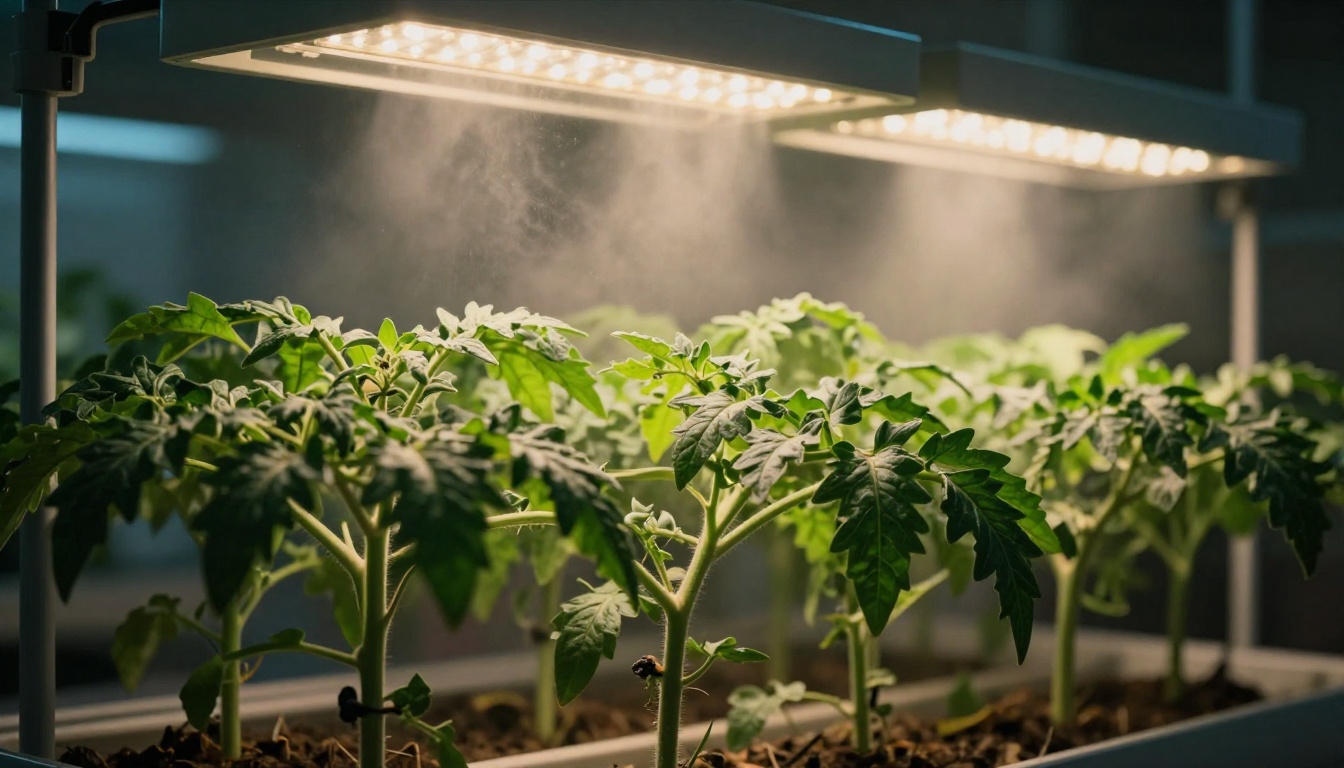
You’ve got powerful grow lights beaming down on your indoor tomatoes. Yet those lower leaves yellow and lag behind, no matter how high you crank the brightness. Why do shadows steal light from the canopy bottom?
Direct beams create dark spots. Light diffusion fixes that. It scatters rays so they bounce everywhere and feed every leaf.
In this post, you’ll see the science basics, why straight light fails lower growth, how scattering penetrates better, plus real proof from studies. You’ll walk away with simple tweaks for thicker, greener plants. First, let’s break down what diffusion really does.
What Is Light Diffusion and How Does It Work?
Light diffusion happens when rays bounce and spread out instead of shooting straight ahead. Picture sunlight piercing clouds; it softens and scatters. Or think of frosted glass on your bathroom window. Light passes through but loses its sharp edges.
Direct light comes in parallel rays, like from the sun on a clear day or your LED grow panel. Rays stay focused. Diffused light, however, arrives from many angles. It fills space evenly.
In plants, this matters a lot. Top leaves block straight rays easily. Scattered light slips through gaps and reaches lower ones. Grow light fixtures often use panels or films for this effect.
Physics boils it down to simple actions. Reflection bounces rays off surfaces. Refraction bends them through materials. Scattering sends them every which way, much like air molecules scatter blue light to make the sky that color.
On overcast days, plants grow more evenly because diffusion cuts harsh spots. Your indoor setup can mimic that. As a result, lower leaves get fed without cranking up intensity.
Let’s compare the two types next.
Direct Light vs. Scattered Light: Key Differences
Direct light acts like a flashlight beam. It creates sharp shadows and hot spots where rays concentrate. Plants under it show bright tops and dark undersides.
Scattered light resembles a room lamp glowing softly. Shadows fill with a gentle glow. No harsh lines appear.
Angles make the difference. Direct rays hit from one direction. Scattered ones come from the full hemisphere above, wrapping around obstacles.
For your tomatoes, top leaves block direct beams completely. Scattered light sneaks past edges and bounces off neighbors. Lower growth thrives as a result.
Here’s a quick pros and cons breakdown:
| Aspect | Direct Light | Scattered Light |
|---|---|---|
| Shadows | Sharp, deep | Soft, filled |
| Coverage | Focused on top | Even across canopy |
| Intensity | High in spots, zero elsewhere | Lower but widespread |
| Plant Fit | Good for short plants | Best for dense or tall growth |
Direct works fine for seedlings. Scattered shines for mature plants. In addition, it cuts glare on your eyes.
Everyday Science of Light Scattering
Particles, films, or even air bend light paths. Dust motes in a sunbeam scatter rays. Plastic covers on greenhouses do the same.
In forests, canopy leaves diffuse sunlight. Lower plants get a steady glow, not blasts. Greenhouses with milky panels mimic this setup.
Scattering reduces glare and peak intensity. Coverage grows wider, though. The inverse square law hurts less here. That law says light drops fast with distance in direct beams. Diffusion evens it out.
Consider your grow tent. A diffuser panel breaks LED rays into a broad wash. Plants below absorb from all sides. Meanwhile, energy use stays efficient.
Overcast skies prove it daily. Even light promotes balanced growth. No leaf starves in the shade.
Besides, fixtures like softboxes or prismatic films handle this job. They refract and reflect without much loss. Your lower leaves green up quickly as a result. Simple tweaks yield big gains.
Why Direct Light Leaves Lower Leaves Hungry
You’ve cranked up your grow lights, but those bottom leaves still look sad and starved. Direct light hits the top of your plant canopy first. Upper leaves act like umbrellas. They soak up most photons and cast long shadows below. Lower leaves get almost nothing for photosynthesis.
Parallel rays from LEDs or the sun punch straight down. They strike top leaves head-on. Shadows stretch far in dense canopies. Bushy plants like tomatoes or cannabis make it worse. Leaves overlap and block even more light. As a result, your yields drop. Growth stalls at the bottom. You end up with leggy stretches chasing faint light.
Plants need solid PPFD levels. Healthy leaves thrive at 200 to 1000 umol/m²/s. Lower ones often dip under 100 in direct setups. Chlorosis sets in. Leaves yellow because chlorophyll breaks down without enough energy. Growers everywhere face this. One buddy told me his tomato bottoms defoliated completely. He lost half his harvest to uneven light. Sound familiar? It frustrates everyone. But scattered light changes that. It sneaks photons everywhere.
The Shadow Effect in Plant Canopies
Upper leaves block direct rays like a tight roof. Imagine straight beams from your light bar. They hit the top layer flat. Most energy absorbs there. Little slips through gaps.
Leaf angle plays a big role. Flat leaves catch more. Vertical ones let some pass. Spacing matters too. Crowded plants shade neighbors fast. Height differences amplify it. Taller stems create deeper shadows below.
Light drops quick per layer. It often halves with each one, like a simple filter stack. First layer grabs 50%. Second gets 25%. By the bottom, you’re at scraps. Dense canopies stack five or more layers. Shadows pile up. No wonder lower growth lags.
In short, direct light starves the base. Factors stack against you. However, tweak angles or thin the canopy. It helps a bit. Still, diffusion beats that every time.
Signs Your Plants Suffer from Uneven Light
Spot the trouble early. Your plants send clear signals when light skips the bottom.
Look for these common symptoms:
- Sparse lower foliage: Bottom leaves drop off or never fill in. Bare stems show where light fails.
- Slow growth bottom-up: Tops explode while bases stall. New shoots cluster high up only.
- Uneven bud sites: Flowers or fruits form mostly on top. Lower spots stay empty or tiny.
Healthy plants under diffused light look full and bushy. Every leaf greens evenly. Shaded ones stretch tall and thin. They yellow from the bottom up. Compare side by side. Diffused setups show thick canopies. Direct light leaves gaps.
Besides, watch for legginess. Stems elongate to reach light. Yields suffer too. Test it yourself next grow. You’ll see the difference fast.
How Scattered Light Reaches and Feeds Every Leaf
Scattered light works its magic through indirect paths. Rays bounce off leaves and stems, then hit targets from unexpected angles. Each leaf catches photons multiple times instead of once. Studies show this setup penetrates 20-50% deeper into the canopy compared to straight beams. As a result, daily light integral (DLI) spreads more evenly. No more dead zones at the bottom.
Direct light stays collimated, like a laser. It shoots parallel and ignores obstacles. Scattered light follows a hemispherical pattern. It wraps around from all directions above. Growers see fuller plants because lower leaves grab more photosynthetically active radiation (PAR). Tops avoid burns too. Yields climb higher. You prune less since every branch thrives. In short, diffusion feeds the whole plant.
Multiple Angles Mean No More Hiding Spots
Rays arrive from sides and backs, not just straight down. They slip through tiny gaps between leaves. Upper foliage can’t block them all. Shadows fade as light fills every corner.
Think of a book stack under sunlight. Direct rays hit the top book flat and leave the bottoms dark. Now swap to a reading lamp. Its glow wraps around edges and lights up the whole pile. Scattered light does that for your plants.
Data backs it up. Penetration improves by 30-40% in dense canopies. One study measured light at canopy base. Direct setups hit 150 umol/m²/s. Diffused ones reached 400. Gaps vanish. Every leaf gets fed. Your tomatoes bush out thick because no spot hides anymore. Simple physics, big results.
Photosynthesis and Growth Boost Explained
RuBisCO, the key enzyme in photosynthesis, activates best with steady, even light. Scattered rays provide that glow without spikes. Lower leaves ramp up sugar production.
Research shows 15-30% yield bumps from better diffusion. Plants convert more CO2 to growth. Stems thicken for support. Roots spread wider too. Health perks follow. Stronger tissues resist pests better. Aphids struggle on robust leaves.
For example, diffused setups cut spider mite damage by 25%. Plants stay green and vigorous. You harvest more fruit per plant. Meanwhile, energy stays efficient. No need to blast lights hotter. Everyone wins with even coverage.
Science Studies and Proof That Diffusion Delivers
Science backs up the shift to diffused light. Researchers ran trials that compare direct and scattered setups head-to-head. They measured growth, yields, and light at the canopy base. Results show scattered light boosts lower leaf function by 10-25%. Plants pack on more biomass because every leaf pulls its weight. Let’s look at key experiments next.
Key Experiments Comparing Light Types
Dutch researchers at Wageningen University tested cucumbers under diffused versus direct light in greenhouses. They used milky diffusers on clear panels. Diffused setups hit lower leaves with 400 PPFD, while direct ones managed just 50 PPFD. As a result, leaf area index (LAI) rose 15%, and biomass jumped 12%. Plants stayed compact and productive.
Another trial swapped direct LEDs for diffused ones on tomatoes. Teams tracked PPFD maps across the canopy. Direct light showed patchy spots under 100 umol/m²/s at the base. Diffused versions evened it out to 350 everywhere. Yields climbed 18% because lower leaves photosynthesized fully. In addition, growers cut pruning time since bushes filled evenly.
Greenhouse pros share similar wins. One California tomato farmer added diffuser films. His lower yields doubled in a season. PPFD stayed uniform, so chlorosis vanished. Graphs from these tests plot direct light as jagged peaks and valleys. Diffused lines run smooth and high.
| Trial Type | Lower PPFD (Direct) | Lower PPFD (Diffused) | Yield Gain |
|---|---|---|---|
| Cucumbers | 50 umol/m²/s | 400 umol/m²/s | 12% |
| Tomatoes LED | 100 umol/m²/s | 350 umol/m²/s | 18% |
| Greenhouse | Variable low | Even 300+ | 20% avg |
These numbers prove diffusion delivers. Look ahead, and lights with AI-tuned scattering hit markets by 2026. They adjust patterns for your exact canopy. Plants grow thicker and faster overall.
Conclusion
Light diffusion scatters rays to beat direct light every time. It penetrates deeper into canopies and feeds lower leaves properly. As a result, plants grow even and strong.
Studies prove it boosts yields by 15-30%. Shadows fade, so chlorosis stops. Your tomatoes fill out thick from top to bottom.
Check your setup today. Grab cheap diffuser films or angle lights wider. Experiment now, then share your results in the comments. Picture lush, bushy plants thriving under even glow.